Tackling Heat Exposure in Dhaka
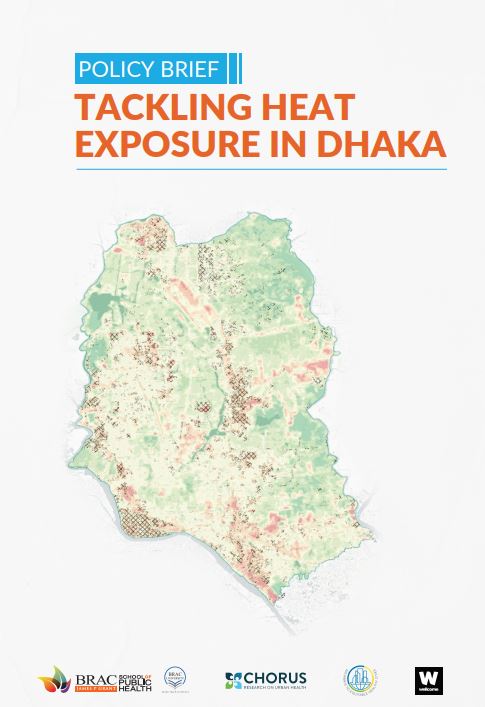
CHORUS Innovation Fund Project, on ‘Health Vulnerability from Heat Waves, Adaptation, and Solutions in Dhaka City: Validation through Ground Truthing of Satellite Imageries and Cross-Sectional Survey’, led by Anisur Rahman Bayazid at BRAC James P Grant School of Public Health, aims to map land surface temperature (LST) and identify the most heat vulnerable areas in Dhaka city, exploring community adaptation strategies against extreme heat conditions. The study also estimates the heat vulnerability index to assess the adverse health impacts among people of different ages, gender, and occupation groups living in the heatwave-vulnerable locations of Dhaka City.
The study comprises three work packages based on a multimethod design comprising GIS mapping, literature review, secondary data analysis, and qualitative components: (a) Land surface temperature (LST) Mapping and Vulnerable areas identification, (b) FGDs and KIIs with relevant stakeholders, and (c) Preparing a Heat Vulnerability Index (HVI) using data from WP1 and WP2, secondary data, and literature review.
A temperature monitoring campaign was held in July-September 2023, to analyse temperature exposure to identify areas with maximum heat exposure, and the people within that areas were interviewed. The monitoring took in-situ near surface air temperature (3 to 6 meters above ground) measured from 8 fixed (continuous 60 days) and 61 rotating (continuous 72 hours) sites comprising 5 land use categories. The monitoring data was collated to bridge knowledge gaps and inform policy action.
This Policy Brief highlights that heat exposure is not uniform across the city, nor is vulnerability. Four neighbourhoods of Dhaka were identified with the highest heat exposure. These areas are among the major Central Business Districts, and cover diverse land use characteristics. These areas need urgent area-specific mitigations, and multisectoral collaboration to combat heat vulnerability. It was also found that informal settlements are exposed to more heat that others, and these areas need assistance during heat waves to provide access to clean drinking water; medical facilities; shades for outdoor markets and adequate walkways.