

WHO Strategic Action for Urban Health: Three CHORUS Projects Featured as Case Studies
As part of the World Health Organisation’s (WHO) initiative on strategic action for urban health, and the global report launched on World Cities Day 2025: Taking a strategic approach to urban health: a guide for decision-makers, WHO has collated a series of case studies to highlight new and creative ways to act strategically on urban health – aligning urban systems, policies, and partnerships. Each study presents a concrete example of how governments, communities, and other partners have worked across sectors and scales to embed health and equity into urban decisions.
1. Adding Data to Bangladesh’s DHIS2 Using the Simple App
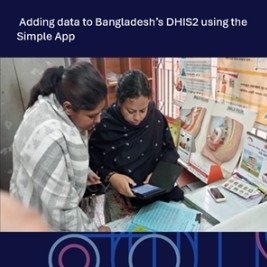
WHO highlights the work of the CHORUS project in Bangladesh, and ARK Foundation’s partnership with the Bangladesh Non-Communicable Disease Control (NCDC) programme at the Ministry of Health, and the Ministry of Health and Family Welfare, to strengthen NCD information systems in urban areas through the adaption of the ‘Simple App’. WHO uses this work as a Case Study to demonstrate how strengthening data systems in urban primary care can improve the visibility of NCD burden, enable coordinated planning and support more coherent urban health governance.
2. Linking Public and Private Healthcare Providers to Improve Non-Communicable Disease Services in Pokhara Metropolitan City, Nepal

WHO highlights the work of HERD International in Nepal, and the CHORUS project working with Pokhara Metropolitan City co-creating initiatives to strengthen NCD service delivery by improving linkages among private pharmacies and public health facilities. Prior to the initiatives, information about hypertension and diabetes services was dispersed across different public and private providers, with significant information gaps that limited decision makers’ ability to understand patterns of service use and plan coordinated programming and service delivery initiatives. By establishing shared data standards, and building capacity for routine reporting across provider types, this improved local health data can create new pathways for addressing complex urban health challenges. WHO also highlights this initiative to demonstrate the broader principle of strategic urban health practice: that decisionmakers need integrated, locally relevant data that capture interactions among diverse service providers. When decision-makers can see how clients navigate the system, where service gaps emerge, and how interventions perform across contexts, they are better positioned to design coordinated, equitable responses.
3. Exploring Multisectoral Collaboration for Health Improvement in Ashaiman Municipality, Ghana

WHO also draws on the work of a CHORUS Innovation Fund Project, led by Patience Mamattah (University of Ghana, and Ashaiman Municipal Health Directorate, Ghana Health Services) to demonstrate how a national mandate for Health in All Policies (HiAP) can service as a practical entry point for strategic urban health action at the local level. Whilst the CHORUS Project highlighted a limited understanding of HiAP at the local level, along with low levels of engagement and capacity, it also found opportunity to leverage the national framework. The Municipal Health Directorate and its partners were able to use the HiAP mandate to promote a shared understanding of how different departments contribute to health outcomes, even amid the municipality’s complex challenges related to poverty, unplanned growth, and environmental conditions. The national framework also enabled Ashaiman to revitalise existing coordination structures. These steps strengthened planning coherence, improved participation and elevated the visibility of health within the Assembly’s work.