
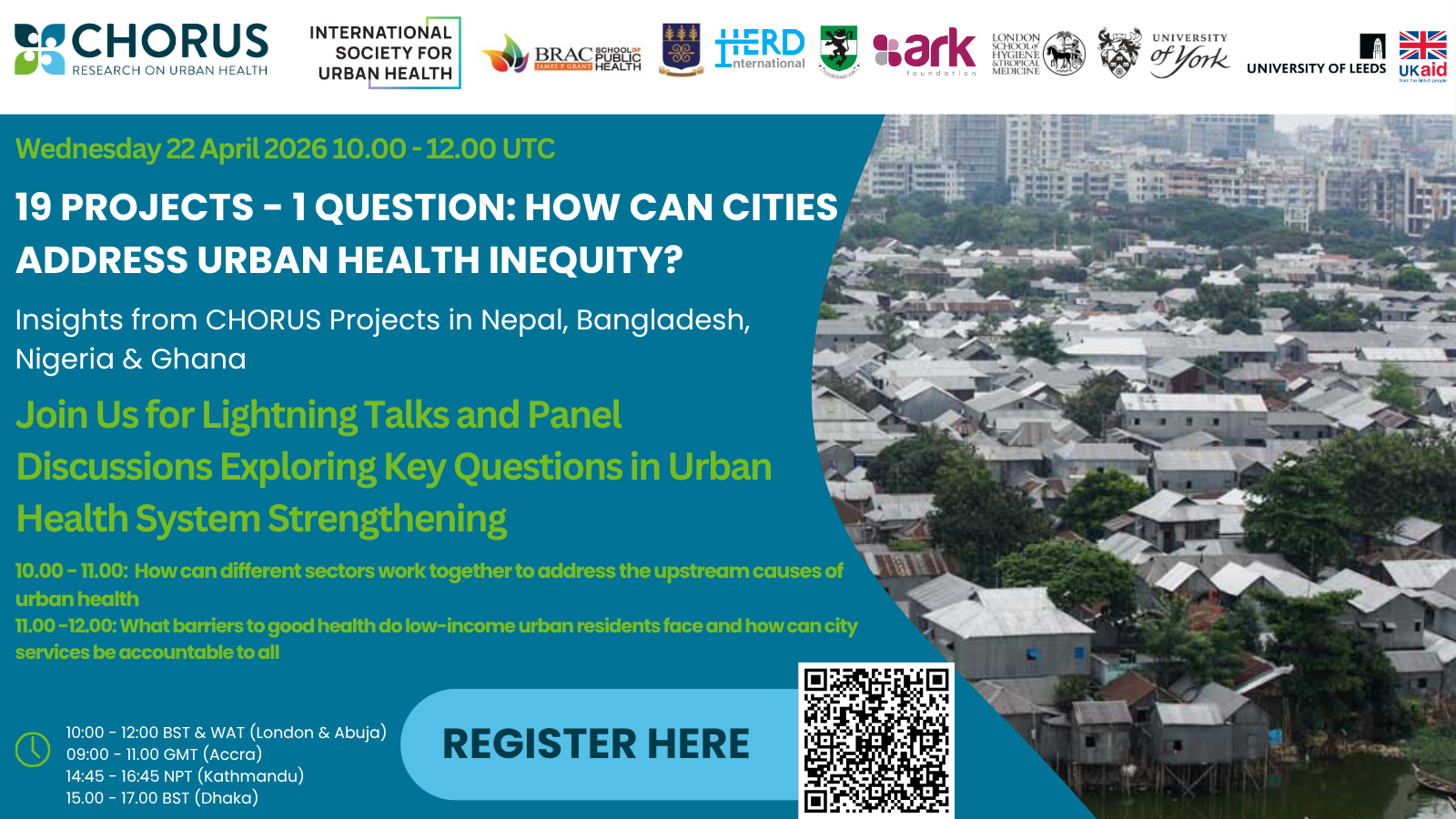
19 Projects, 1 Question: How Can Cities Address Urban Health Inequity?
Early and mid-career researchers from four low- and middle-income countries share insights on addressing urban health inequities
As countries grapple with the burgeoning effects of rapid urbanisation, informal settlements and slums in cities are facing pronounced health challenges due several factors, including the lack of basic infrastructure, overcrowding and changes to lifestyle practices. Meanwhile, marginalised groups living in these areas are seeing a worsening of health outcomes as gaps persists in urban health services and systems. Through a series of 17 ‘Innovation Fund’ and 2 PhD projects, all led by early to mid-career researchers from Bangladesh, Ghana, Nepal and Nigeria, topics related to these issues were explored.
In a CHORUS webinar in April 2026, researchers shared insights from their projects focused on two questions linked by their aim to address urban health inequities:
Session 1: How can different sectors work together to address upstream causes of urban health inequities, with a focus on actions at city and local government level?
Session 2: What barriers to good health do low-income urban residents face and how can city services be accountable to all?
The webinar included 19 lightning talks from researchers, followed by a panel discussion chaired by Professor Shafiq Rahman, University of Dhaka, in Session 1; and Professor Zahidul Quayyum, BRAC James P Grant School of Public Health, in Session 2.
The presentations showcased how cities can tackle urban health inequities through multisectoral action, better data, and meaningful community engagement. The projects span themes from mental health, equity and intersectionality, schools and health, urban crime, urban heat maps, AMR, media and health communications, bringing together careful research with practical, locally led solutions and interventions. They highlight practical pathways from evidence to impact for more inclusive, accountable urban health systems.
View the presentation slides here:
Researchers followed up their presentations in this Q&A blog, providing additional insights into how urban health inequities can be addressed through multisectoral collaboration and engaging communities.
Multisectoral Collaboration: How can different sectors work together to address upstream causes of urban health inequities, with a focus on actions at city and local government level
Question: What is a practical or realistic example of multisectoral collaboration you’ve seen at city or municipal level, and why did it work?
“In Bangladesh, a prominent and practical example of multi-sector collaboration at the municipal and city corporation level can be demonstrated through our CHORUS Project, which focused on strengthening the urban primary health care system to manage non-communicable diseases in urban primary health care centres. Under this initiative, we worked closely with NGO-run urban primary health care centres operating under the Urban Primary Health Care Services Delivery Project, as well as government outdoor dispensaries managed by the Ministry of Health and Family Welfare. After successful implementation of the project, the Ministry of Health and Family Welfare scaled up this project in Dhaka and Khulna City, and even though there were no such collaboration between the ministries prior to the project, after implementation the GNCC continued collaborated with the NCDC DGHS.
The CHORUS project involved a complex network of stakeholders, including the local government division, city corporations and various NGOs and the Ministry of Health and Family Welfare. From the outset, we formed a technical working group that included representatives from all stakeholder groups and organized regular meetings. This platform enabled continuous coordination and joint decision making, problem solving, and alignment of priorities from planning through implementation and monitoring. So, this collaborative structure worked effectively because it ensured shared ownership, clear communication and integration of services across different sectors, and ultimately strengthening the delivery of NCD care at the urban primary health care level”. (Samina Huque, ARK Foundation, Bangladesh)
Question: What mechanisms or incentives are already in place that can promote cross sector working?
“There are already several mechanisms in place. Existing mechanisms in relation to anti-microbial resistance include governmental regulatory frameworks (for example, the Directorate General for Drug Administration in Bangladesh), AMR awareness programmes, professional associations, and monitoring systems such as mobile courts. These provide a foundation for cross-sector collaboration, which can be strengthened through better coordination and shared accountability.” (Asiful Chowdhury ARK Foundation, Bangladesh)
Question: How can data projects such as the urban deprivation index, heat vulnerability index, or small‑area poverty indices be used by city or local government governments to inform urban planning, promote cross sector working, and promote the monitoring the impact of reforms and policies for urban health systems?
“The urban deprivation index was calculated for the first time in Nepal, as part of the Innovation Fund project, and this deprivation index gives the value of the deprivation of 9 urban municipalities in Nepal. So, every municipality has the value of the deprivation index, and they know which are the categories they include. So, this deprivation value can be used by the federal level or local level governments for evidence-based planning. The deprivation index includes various domains, such as health impact structure, environment, housing, and governance. So, with all this detail, the municipality can see that which domains have the highest evidence of inequality and they can take this into account in the planning. With this different data collated into an index, this enables evidence based cross sector planning. (Sampurna Kakchapati, HERD International, Nepal)
“The heat vulnerability index is already used in some cities, for example in New York City they have a dashboard that anyone can see the areas which are more vulnerable and which are not. By creating this dashboard, different authorities of government, including the health department; meteorological department; environmental department; city corporations; department of industry; department of commerce; department of transport, can work together to share their data, and to create the index. By this sharing, and by this collaboration, progress can be made to improve living conditions, with each department knowing what needs to be done to create the environment suitable for the people. So, I think city governments, through collaborating on such data projects and creating data dashboards that are shared and owned across the sectors, can encourage multi-sectoral working”. (Anisur Bayazid, BRAC James P Grant School of Public Health, Bangladesh)
Question: Are local city governments allocated sufficient resources for health, and what should be done to ensure existing budgets are spent to benefit health. & given the complex flow of funds between departments, and between government, city corporations and service providers, how can these be monitored to ensure accountability and improve cross sector working?
“The short answer is no. Our local city governments in Bangladesh, such as city corporations, are severely underfunded when it comes to primary healthcare. While city corporations may boast massive overall budgets, for instance, the Dhaka North City Corporation (DNCC) has an annual budget exceeding 6,000 crore taka but the reality is that the actual allocation for health is rather small. Even within the designated health department budget, the vast majority of funds are swallowed up by civic services like mosquito control and waste management. The Ministry of Finance does not provide specific line-item budgets for urban health; instead, funds arrive as broad “Transfer Budgets,” as Grants under a specific economic code which was around 2 Cr BDT in Fiscal Year (FY) 24-25 and the central government gives lower priority to city corporation operating budgets because cities are expected to generate their own revenue.
To ensure that existing resources actually translate into better health outcomes, our city corporations need a structural overhaul in how they plan and spend. A crucial first step is to put more emphasise on collecting the health tax. In the last FY 2024-2025, the Dhaka North City Corporation (DNCC) collected more than 8 Cr BDT as Health Taxes and plan to generate more than double this FY 25-25. However, the amount that they collected are not directly transferred to primary healthcare services. Currently, the FY 25—26 Budget only lists around 5.2 Cr BDT for primary healthcare for its 5.99 million people (per capita per year only 10 BDT) which is very low. The current healthcare service modality after the Asian Development (ADB) fund withdrawn is running under the leadership of Dhaka North City Corporation. However, the modality follows a cost-sharing model, where the users fee generated 50% of the total costs and the rest of the costs are reimbursed by both the city corporation and Local Government Department under the Ministry of Local government and Rural Development (MoLGRD), despite the citizens are paying health taxes in different modalities. Therefore, the city corporation can consider to increase their Health Tax envelope and then further provide the services to its city residents without any charges.
Also, there must be a transition from treating urban health as a temporary development project to a permanent civic service. Funding care in short term project cycles destroys staff morale, disrupts service continuity, and leads to high turnover. The entire urban primary healthcare should be prioritized within the City Corporation’s permanent revenue and operating budget. Millions of taka are wasted on renting temporary, inadequate spaces for clinics. City corporations must secure government land in every ward to build permanent, city-owned healthcare facilities.
The local governments must modernize their hiring rules. Budget allocations often appear unspent simply because rigid civil service rules and hiring freezes prevent the recruitment of essential staff, like sanitary inspectors, sonologists, and anaesthetists.
The financial pipeline for urban health is a complex process which moves from the Ministry of Finance to the Ministry of Local Government, down to the City Corporation, and finally to contracted NGO providers. To ensure accountability and improve cross-sector collaboration, we must modernize how we track this money. Currently, the financial reporting system is process manually which makes the reimbursement, purchasing and other daily documentation process time-consuming, lengthy, resulted in fund allocation and reimbursement delays. Financial reporting must be fully digitized and integrated into the national iBAS++ system.
To truly monitor health budgets, city governments can consider to implement a four-pillar digital dashboard linking key software systems: iBAS++ for budget management, e-GP for procurement, DHIS2 for service provision tracking, and eLMIS for drug and logistics management by following the examples of Ministry of Health and Family Welfare (MoHFW). Significant resources, such as vaccines and family planning commodities from WHO, UNICEF, and the MoHFW, flow directly to clinics and completely bypass the City Corporation’s financial ledgers. These off-budget flows must be valued and formally tagged in national tracking systems to provide a transparent picture of total health expenditure.
To manage these complexities, city corporations must create a dedicated finance unit. Right now, the entire burden of managing multi-layered project budgets falls on the Chief Health Officer, and the accounts department of the city corporation, who are already overwhelmed with multi-sectoral duties. Establishing a dedicated finance unit within the City Corporation’s health department would bridge the gap between departments, audit quarterly expenditures efficiently and prevent the fund disbursement delays.” (Badruddin Saify, ARK Foundation, Bangladesh)
Engaging Communities: What barriers to good health do low-income urban residents face and how can city services be accountable to all?
Question: From experiences in your projects, what barrier to good health for low-income or marginalised urban residents remains least visible to policymakers?
“One of the least visible barriers to good health is the gap between having access to services and actually being able to use them effectively to protect health.
In our WASH study, some services “technically existed” like water sources, sanitation options, even some hygiene infrastructure. But our baseline findings showed that these did not translate into effective use. For example:
Only a very small proportion of households had functional handwashing stations at the point of use,
- Open defecation remained common,
- And there was a high burden of diarrhoeal illness.
- So the issue is not just absence of services, it is that the conditions required to use those services safely and consistently are missing.
- That gap is driven by structural factors that are often less visible to policymakers:
- Low awareness of safe practices
- Weak regulation and enforcement
- Poor maintenance of infrastructure
- Limited technical expertise and coordination across sectors
- And limited community capacity to demand accountability
These factors shape how people interact with available services, and ultimately determine whether access translates into health outcomes.
To address this, our findings suggest that city-level policymakers need to move beyond service provision alone and focus on how services function in real-life contexts. This includes:
- Working with communities to co-design solutions, so services reflect actual needs
- Strengthening local governance and accountability structures, such as community monitoring systems
- Investing in behaviour change and community awareness, to improve utilisation
- And ensuring technical expertise and support from government agencies, so services remain functional over time.
So ultimately, improving access is not just about expanding services, but also about ensuring that services are accessible, acceptable, and consistently used, through stronger alignment between communities, providers, and policymakers. The real barrier is not just lack of services, but the lack of systems that ensure those services translate into health protection.” (Iheomimichineke Ojiakor, Health Policy Research Group, University of Nigeria)
Question: What does “meaningful engagement” with marginalised urban residents look like, and how did you try to achieve this?
“Meaningful engagement goes beyond simply inviting community representatives to meetings. It requires creating spaces where marginalised urban residents can directly express their needs and priorities, and where their input visibly influences decisions. In our study, although engagement structures such as town hall meetings and consultations exist, they often rely on representation, which can filter or dilute community voices. As a result, some groups, particularly those in informal or less organised sectors, remain underrepresented.
From our findings, meaningful engagement should involve more direct, localised, and inclusive approaches, including engaging specific community groups, ensuring regular consultations at the electoral area level, and providing feedback on how community input shapes planning and budgeting decisions. Without this, engagement risks becoming symbolic rather than impactful”. (Henry Delali, University of Ghana)
“Meaningful engagement goes beyond consultation. It means communities help define the problem, shape the solution, have the capacity to act, and can sustain the change themselves. In our WASH project, we tried to achieve this in four ways:
– First, we conducted a baseline assessment to understand community perspectives and identify key challenges. We then co-designed solutions with over 30 stakeholders across state, LGA, and community levels, resulting in 18 context-specific interventions grounded in the lived realities of urban slum residents.
– Second, we invested in capacity building. We trained 37 stakeholders across sectors, so they were not just invited into the process, but were equipped to actively implement and support WASH interventions.
– Third, we carried out community WASH sensitisation campaigns, reaching over 400 residents through practical lectures, demonstrations, IEC materials, and local mobilisation. That was important because engagement is not only about involving leaders; it is also about making sure households themselves understand the health risks, recognise unsafe practices, and feel able to change them.
– Fourth, we embedded engagement into everyday structures. At the community level, we established BORESAFE committees for monitoring and accountability around boreholes. At the school level, we introduced WASH clubs, which created peer-led platforms for students to promote hygiene and sanitation practices, with effects extending into households and the wider community.
At endline, this translated into measurable changes in hygiene and sanitation behaviours from our survey data, and our FGDs and IDIs also showed increased community monitoring, stronger ownership, and greater compliance with safe WASH practices. So in our context, meaningful engagement meant moving communities from being recipients of services to co-producers and enforcers of the conditions that shape their health.
Engagement is meaningful when communities are not only consulted, but informed, equipped, organised, and able to sustain change themselves.
(Iheomimichineke Ojiakor, Health Policy Research Group, University of Nigeria)
Question: How can urban health services ensure they reach marginalised groups and respond to their health needs?
“Urban health services can better reach marginalized groups by shifting from facility-based models to people-centred approaches. In our AMR research in urban slums, we found that patent medicine vendors are often the first—and sometimes only—point of care, shaping how medicines are accessed and used. This means we must identify underserved populations using disaggregated data, bring services closer through community outreach, and engage both communities and these frontline providers in designing solutions that reflect real-life care-seeking patterns.
We also applied an intersectionality lens—recognizing how factors like gender, income, and location shape access and use—throughout the research process, from design to analysis. Equally important is making services accessible and inclusive by reducing cost barriers, addressing stigma, and offering flexible, integrated care. Ultimately, reaching marginalized groups requires systems that are responsive, adaptive, and grounded in lived realities.” (Chibuike Agu, Health Policy Research Group, University of Nigeria)
Question: What communication gaps exist between city health systems and residents of urban slums, and how can trust be rebuilt in contexts of misinformation or limited services?
“As urban slums can spring up illegally, governments are trying to find a way to integrate slums into the main community, but in many contexts, they are really not recognised. So, getting information to them in a practical way is challenging. Existing successful communication strategies are through community health workers, who are very trusted for health communications. We also need to ensure urban slum dwellers are involved in the policy formulation process, including through the health community workers, community groups and leaders.” (Delali Kumapley, University of Ghana)
Question: How does the news media framing of urban health issues influence how urban health issues receive attention, and how does this impact whose voices are heard or ignored in policy debates?
“One of the key insights in our media and policy project, was that media plays a critical role in determining which urban health received attention, and which remain overlooked. Currently media coverage is mainly crisis driven, for example dengue or measles outbreaks, hospital crises, or environmental hazards, like air pollution, and they usually receive immediate policy attention (although implementation of policies is a different story!) but the deeper structural drivers of urban health inequity, such as NCDs, poor mental health, or the conditions of slum dwellers and floating residents actually live , these receive far less attention, despite having a far greater burden. Health itself is not often a news priority, with urban health issues receiving even less attention, so it seemed like the coverage of news was shaped by immediacy or news value. We also saw that news coverage also gravitated towards official sources, such as government data, technical experts. Marginalised communities and slum residents’ voices do not receive coverage because of the structural constraints, such as limited investigative capacity, limited data, or in some contexts, limitations of press freedom make reporting issues for marginalised groups even harder. Policy makers themselves also don’t always trust media reporting, regarding it as a ‘starting point for investigation’. The result is a policy discourse that focuses on what is visible and urgent, while systematically ignoring structural and persistent issues of inequity and marginalisation. This is where the gap exists.” (Sabrina Jaigirdar, BRAC James P Grant School of Public Health, Bangladesh)